In today’s digital transformation era, physical infrastructure management has evolved from manual operations into intelligent, interconnected ecosystems. For Chief Information Officers (CIOs) and Chief Technology Officers (CTOs), the challenge is no longer about constructing advanced buildings, but about managing the growing complexity of systems operating within them. This is where a building control dashboard plays a critical role, serving as the centralized intelligence layer that unifies security, fire safety, CCTV, and IoT systems into a single, coordinated control environment.
Paradigm Shift: From Isolated Systems to an Integrated Ecosystem
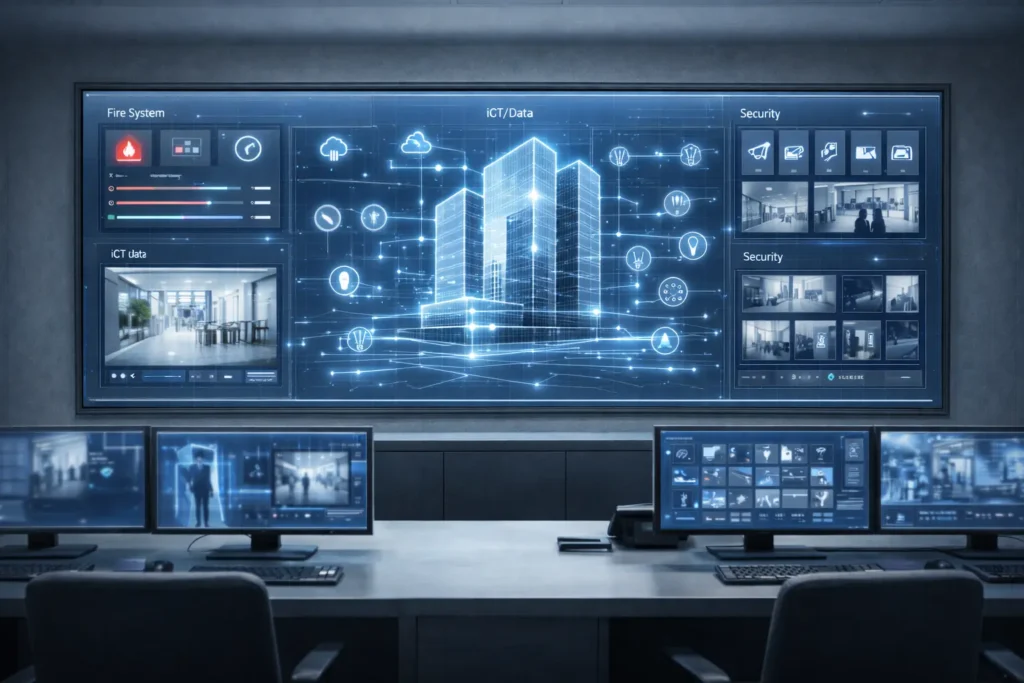
Historically, building systems such as fire alarms, CCTV, access control, and public address (PA) systems operated as standalone platforms. This siloed approach forced engineering and security teams to monitor multiple interfaces from different vendors, often resulting in delayed responses and fragmented information. A modern building control dashboard addresses these limitations by enabling seamless system interoperability within a single environment.
By consolidating all critical functions into a one unified platform, decisions are no longer based on assumptions, but on real-time, contextual data. For building operations and supervision teams, a centralized dashboard provides comprehensive visibility into system status and asset performance, accessible through a single, intuitive monitoring screen.
Integration of Fire Alarm and Public Address (PA) Systems
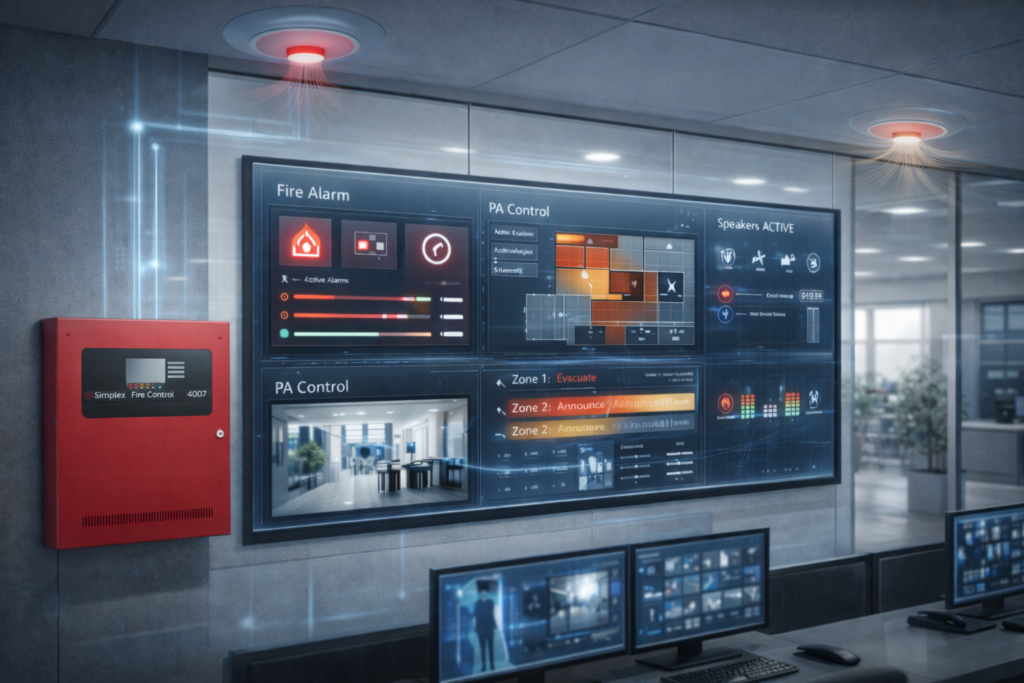
Life safety remains the highest priority in facility management. By integrating fire detection systems with Public Address (PA) systems through a building control dashboard, facilities gain a faster and more coordinated emergency response. When a smoke or heat detector is activated, the dashboard can automatically trigger pre-recorded or live evacuation announcements targeted only to the affected zones.
Through the building control dashboard interface, operators can instantly identify the exact fire location of a graphical floor plan. This real-time visibility enables precise decision-making and reduces the risk of mass panic, as occupants receive clear, accurate, and timely instructions without relying on manual confirmation or delayed communication.
CCTV and Access Control Synergy on a Single Screen
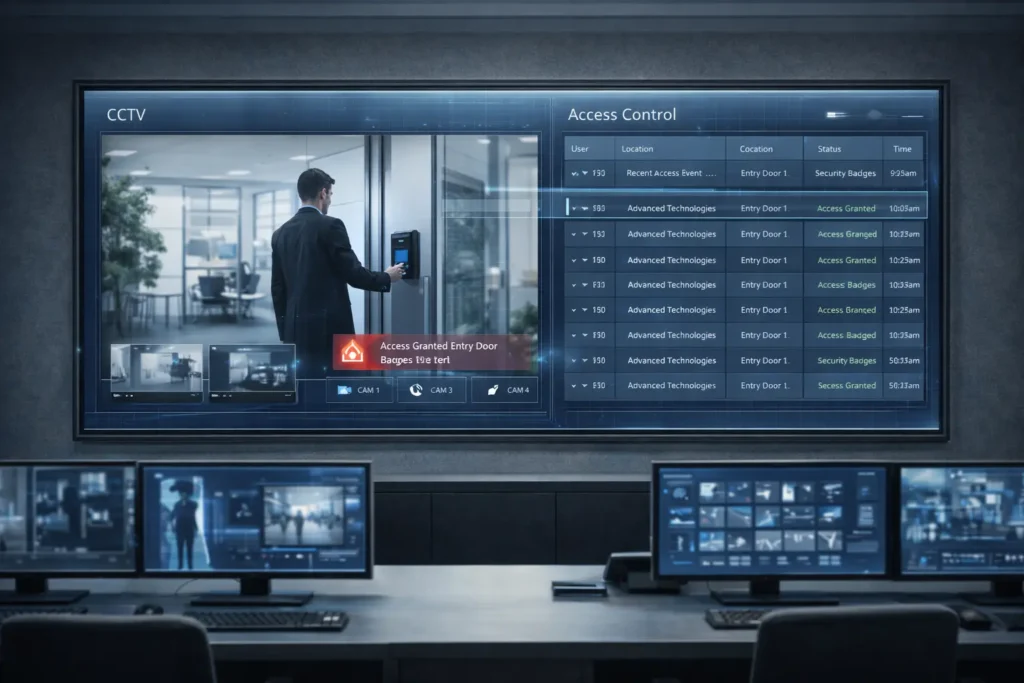
For security teams, validating thousands of daily access log entries can be a major operational challenge. By integrating CCTV with access control systems within a building control dashboard every access event can be instantly verified through visual context. When an unauthorized card is used or an attempt is made to enter a restricted area, the dashboard automatically displays a live video feed from the nearest camera.
This integration ensures that each security event is supported by synchronized visual evidence and timestamped access data. Through the building control dashboard, management teams can conduct security audits, monitor crowd density in critical zones, and initiate centralized area lockdowns during emergencies, all from a single, unified interface.
The Role of IoT and Energy Monitoring
The adoption of the Internet of Things (IoT) has transformed how modern buildings manage energy and resources. Sensors of temperature, humidity,and occupancy sensors are now directly connected to the building control dashboard, enabling real-time data-driven control of HVAC and lighting systems. For example, when occupancy sensors detect that a meeting room is no longer in use, the building control dashboard can automatically dim lighting and adjust temperature settings to energy-saving mode. For C-level executives, this integration supports sustainability and ESG objectives while delivering measurable reductions in operational expenditure (OPEX) through optimized energy consumption.
Technical Architecture and Protocol Interoperability
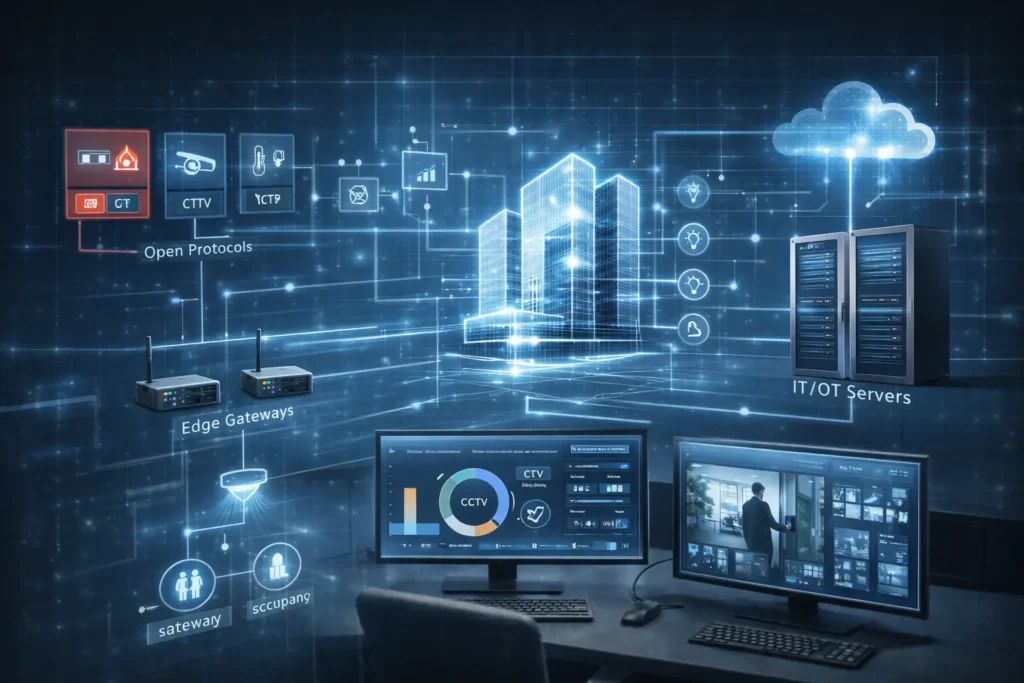
For engineering and IT teams, the technical foundation behind a building control dashboard is critical. A reliable dashboard must support various open communication protocols such as BACnet, Modbus, LonWorks, and REST-based APIs to ensure interoperability between systems and avoid dependency on proprietary vendor ecosystems. Without open protocols support, long-term scalability and system flexibility become limited.
An effective architecture typically combines edge gateways for local data processing, ensuring low latency for critical systems like fire detection and security, with centralized servers or cloud platforms. This design allows the building control dashboard to deliver real-time performance on-site while remaining securely accessible to management through private networks or VPN connections, anytime and anywhere.
Why CIOs and CTOs Must Prioritize This Integration
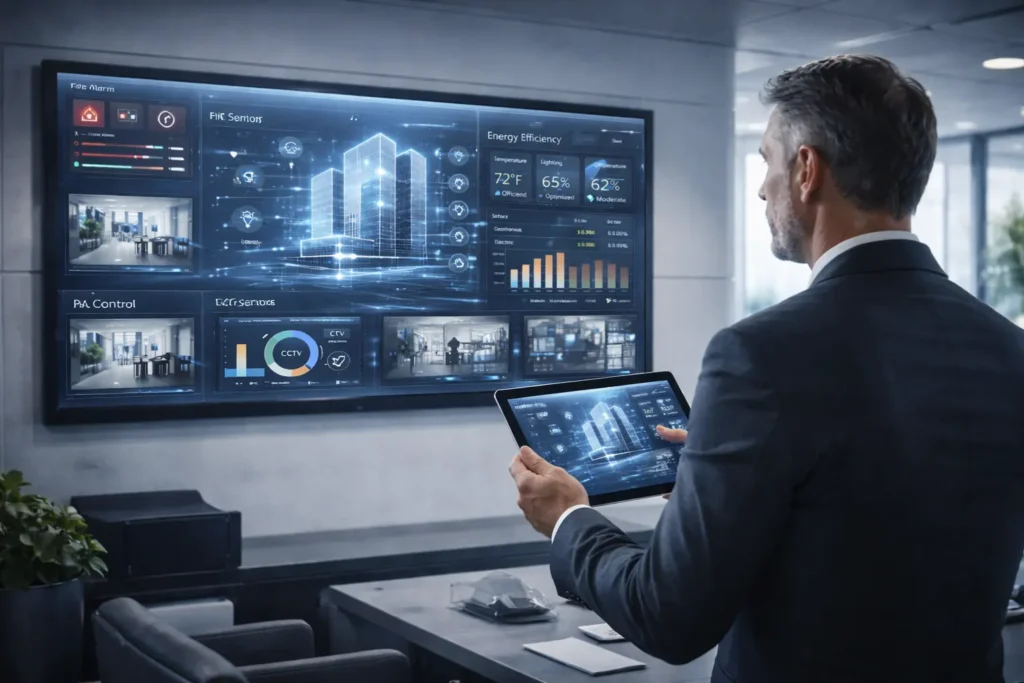
Investing in a building control dashboard should be viewed not merely as capital expenditure (CAPEX), but as a long-term strategy to maximize return on investment (ROI). For CTOs, this integration simplifies system maintenance by centralizing oversight and enabling predictive maintenance capabilities. Based on real-time and historical usage data, the dashboard can generate early alerts before equipment failures occur, reducing downtime and unplanned repair costs.
From a data management perspective, a building control dashboard delivers comprehensive analytical reporting across multiple building functions. Historical insights into space utilization, energy and water consumption, and access patterns can be translated into strategic intelligence for office expansion planning, facility optimization, and long-term infrastructure decision-making.
Operational Efficiency and User Experience (UI/UX)
Technical capability alone is not enough if systems are difficult to operate. For a building control dashboard, intuitive UI/UX design is essential, as operators often work under high-pressure conditions and require clear, prioritized information. Clean dashboards that highlight critical alarms, system status, and real-time alerts enable faster response and better decision-making.
A well-designed building control dashboard allows facility teams to monitor overall building performance at a macro level while still enabling detailed drill-downs into individual components, such as a single lighting fixture, sensor, or access point. This balance between simplicity and depth makes the dashboard a highly effective operational tool for daily building management and emergency response.
Conclusion
As we move toward 2026 and beyond, buildings will continue to evolve into intelligent, data-driven, and environmentally conscious environments. Establishing a strong technological foundation through an integrated building control dashboard is no longer optional, it is essential for organizations that aim to remain competitive, resilient, and operationally efficient. By unifying fire systems, CCTV, access control, public address, and IoT platforms, facilities can achieve higher safety standards, improved occupant comfort, and more responsible energy management.
To bring this vision of a secure and efficient smart building to life, Sepro Indonesia stands ready as your strategic partner. From system architecture consultation to full-scale implementation, Sepro delivers integrated solutions supported by expert teams and proven technologies. With Sepro Indonesia, your facility operations are centralized, intelligent, and fully controlled through a single, reliable building control dashboard designed for the future.