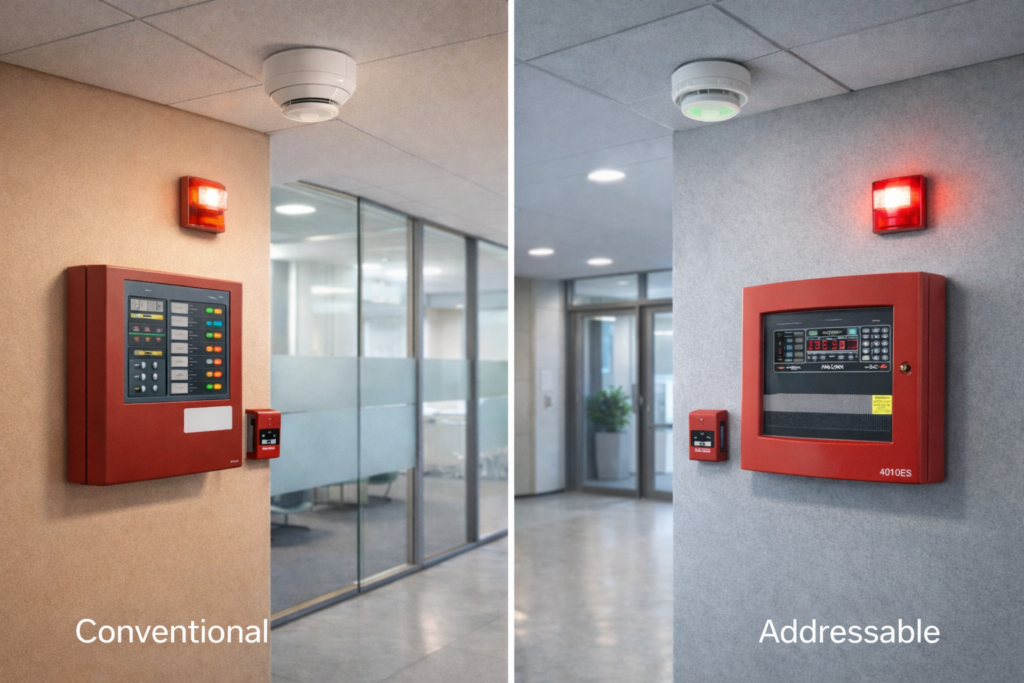
Building a commercial or residential property is a major investment, but a single misstep in fire protection can put everything at risk. When comparing addressable vs conventional fire alarm systems, many building owners focus only on upfront cost, without fully understanding the operational consequences of that decision.
Imagine a fire alarm activating at 2 AM in your ten-story office building. The control panel displays only a generic alert “Fire in Zone 4.” Security personnel lose valuable time searching through multiple rooms on the same floor to locate the source, while smoke continues to spread. In fire emergencies, those lost minutes can determine whether an incident is contained or escalates into a life-threatening disaster.
You don’t have to gamble with safety. Understanding the key differences in Addressable vs Conventional Fire Alarms systems is essential to selecting a solution that matches both your budget and your building’s risk profile. By knowing how each system functions in real emergency conditions, building owners can make informed decisions that protect lives, assets, and long-term investments.
1. Conventional Fire Alarm Systems: The Reliable Classic
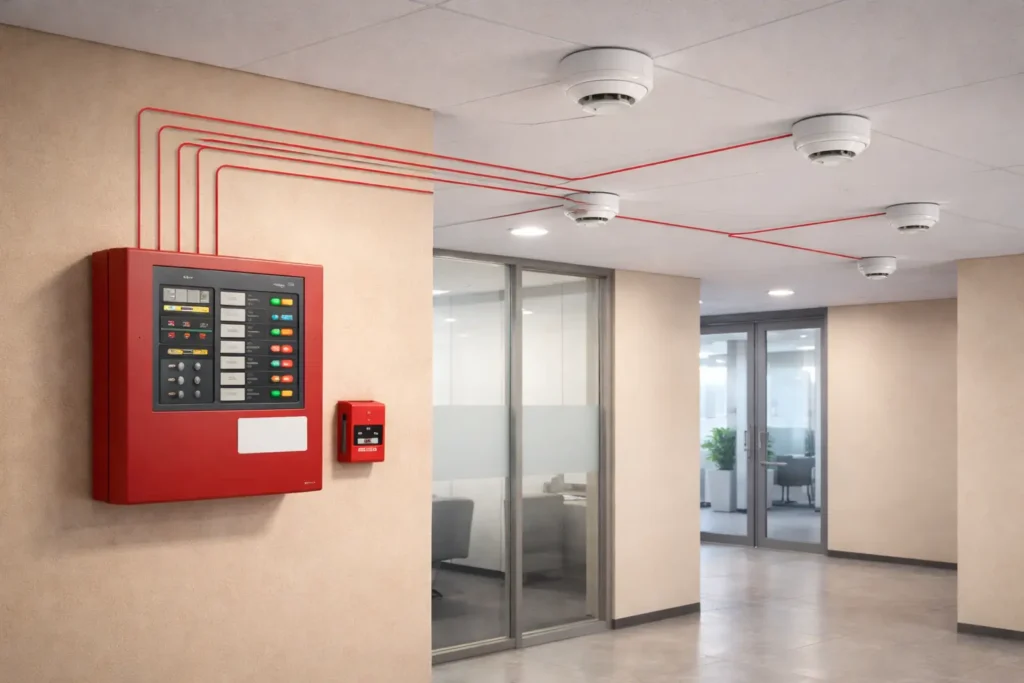
Conventional fire alarm systems have long been a standard solution, particularly in small to medium-sized buildings. In this approach, a building is divided into multiple zones, with smoke detectors, and heat sensors within each zone connected to a single circuit. When one device is activated, the control panel identifies only the affected zone rather than the exact device location. In the context of addressable vs conventional fire alarm systems, this design is simple and cost-effective, but it can result in slower response times during emergencies due to limited location accuracy.
Pros:
- Cost-Effective Hardware
Control panels and detectors (smoke, heat, flame) are generally more affordable than addressable systems, making them suitable for projects with limited budgets.
- Simplicity and Universality
As analog-based systems, conventional fire alarms do not require proprietary software. Installation and maintenance can be handled by most fire alarm technicians without specialized manufacturer training.
- Effective for Small Spaces
In small buildings such as retail shops or open-plan warehouses, identifying the fire location is straightforward, as the alarm activation is immediately visible within the zone.
- Lower Component Complexity
With fewer intelligent components, conventional systems have reduced risk of software-related issues, making them stable and easy to maintain in basic applications.
Cons:
- Vague Incident Location
The system identifies only the affected zone, not the exact device. If a zone covers multiple rooms, responders must manually check each area to locate the fire, which delays response time.
- Labor-Intensive Wiring
Each zone requires a dedicated cable loop connected directly to the control panel. In larger buildings, this results in extensive cabling, higher installation complexity, and increased labor costs.
- Limited Fault Monitoring
Conventional systems lack detailed device-level diagnostics. When a fault occurs, the panel typically indicates a general zone issue without identifying the specific detector or cable fault.
- Higher Risk of False Alarms
These systems cannot differentiate between actual smoke and environmental factors such as dust or steam, increasing the likelihood of nuisance alarms and unnecessary evacuations.
2. Addressable Fire Alarm Systems: The Intelligent Choice
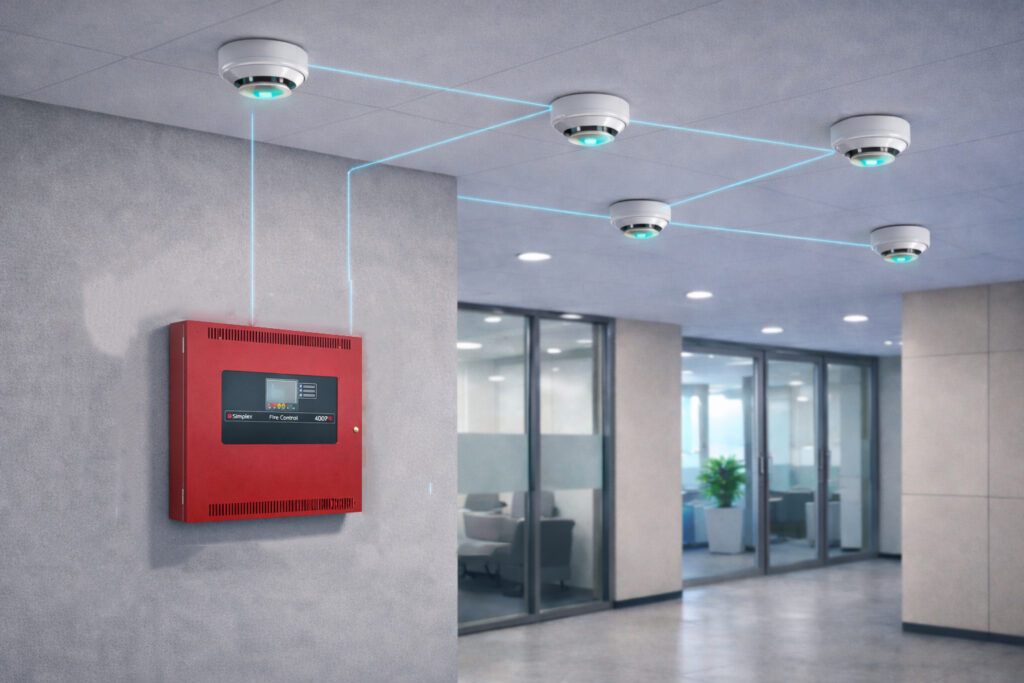
Addressable fire alarm systems represent the modern, intelligent approach to fire protection. In this system, each device such as smoke detectors, heat sensors, or manual call points, has a unique digital address (ID) that allows precise identification.
All devices are connected via loop wiring configuration, enabling two-way communication between the control panel and every individual device. This allows the system to pinpoint the exact location of an alarm or fault, making addressable vs conventional fire alarm systems a critical consideration for buildings that require faster response times, higher accuracy, and greater operational control.
Pros:
- Pinpoint Accuracy (Point Identification)
Each device has a unique address, allowing the control panel to display the exact alarm location (for example, room number and floor), enabling faster and more targeted emergency response.
- Reduced Cabling and Installation Effort
Using a loop configuration, a single circuit can connect hundreds of devices, significantly reducing cabling requirements and overall installation labor.
- Smart Sensing and Drift Compensation
Addressable detectors can monitor their own condition and alert maintenance teams when cleaning is required, minimizing false alarms caused by dust or environmental changes.
- Advanced System Logic
The system can be programmed for functions such as phased evacuation, activating alarms only in affected areas to reduce panic in high-rise buildings.
- Remote Monitoring and Control
Many addressable systems support remote access via computer or mobile devices, allowing facility managers to monitor system status and incidents in real time.
Cons:
- Higher Initial Investment
Addressable systems typically require a higher upfront cost, as the control panel functions as an intelligent processor and each detector contains a built-in digital chip.
- Configuration Complexity
These systems require proper programming and commissioning. Each device must be configured through dedicated software or the panel interface, making installation more complex than conventional systems.
- Proprietary System Dependencies
Some manufacturers use proprietary software or access controls that limit servicing to authorized partners, which can reduce flexibility in maintenance and long-term support.
- Electronic Sensitivity
As fully digital systems, addressable fire alarms may be more sensitive to power surges or electromagnetic interference if installation standards, grounding, and cable shielding are not properly applied.
Summary Comparison Table for Quick Reference

| Feature | Conventional | Addressable |
| Detection | Broad (Zone-based) | Specific (Exact device/location) |
| False Alarm Rate | Higher (Analog) | Lower (Digital/Smart sensing) |
| Wiring Path | Multiple radials (Heavier cabling) | Single Loop (Lighter, more efficient) |
| System Health | Limited (Zone-level fault only) | High (Individual device monitoring) |
| Programming | Not required | Required (via Software) |
| Maintenance | Manual testing of all devices | Self-diagnostic reporting |
The “Building Match”: Which One Do You Need?
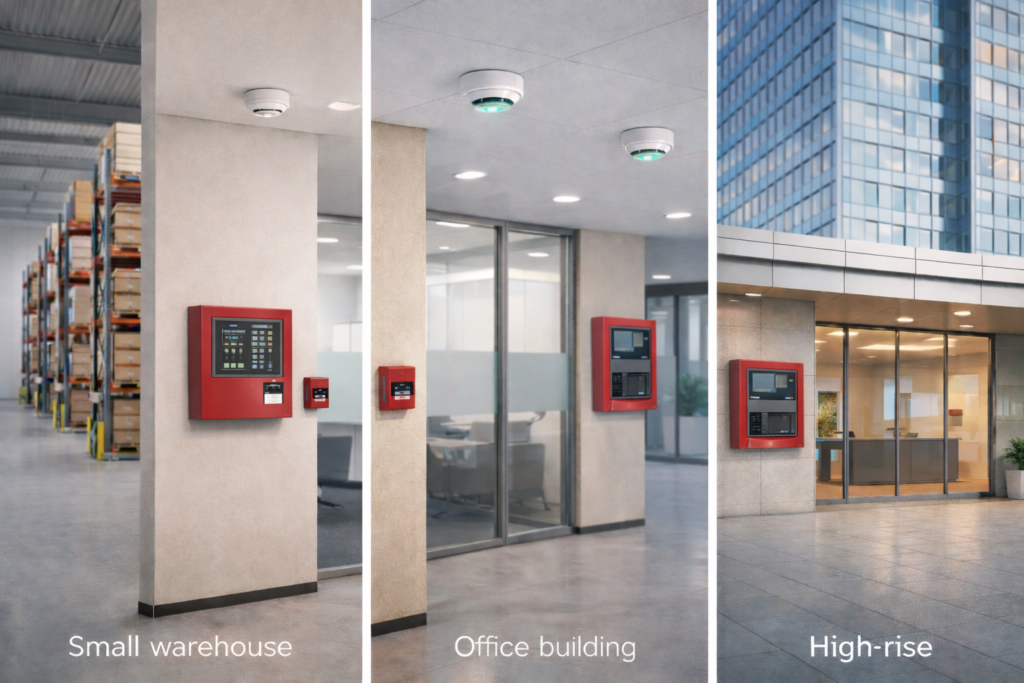
Choose a Conventional Fire Alarm System if:
- You own a small, single-story property such as a retail shop or a basic warehouse.
- Your building has a simple layout and a limited upfront budget.
- Local fire regulations require only zone-based fire detection without detailed point identification.
Choose an Addressable Fire Alarm System if:
- You manage a high-rise building, hotel, or hospital where fast and controlled evacuation is critical.
- You want to reduce operational disruption caused by false alarms.
- You need a system that can be easily expanded or reconfigured as the building grows.
- You prioritize long-term efficiency through lower maintenance effort and reduced cabling labor costs.
Safety Over Price
While a Conventional system may reduce costs upfront, an addressable fire alarm system is an investment in response time, and during a fire emergency, time is the most critical factor. Choosing the right systems ensures faster detection, clearer information, and more effective action when it matters most. Ultimately, the right decision protects not only your property and assets, but also the lives within your building.
Ready to secure your building with the right protection?
Contact Sepro Indonesia to consult with our fire safety experts and receive a professional assessment tailored to your building’s needs.